In a recent interview with Alexis Soloski, playwright Edward Albee discussed Thornton Wilder and the Barrow Street Theatre production of Our Town. Read the full interview in the Village Voice.

Edward Albee.jpg
Edward Albee has won Obies, Tonys, Pulitzers, and membership in a pantheon of American playwrights that includes Eugene O'Neill, Tennessee Williams, and Arthur Miller. (He thinks Thornton Wilder ought to make the list, too.)

VV: [Academics] talk about you as part of a tradition of great American playwriting, as an inheritor to O'Neill, to Williams, to Miller.

EA: Everybody forgets the most important of those: Thornton Wilder. If you're going to have those three others on that list, you have to include Wilder. O'Neill is a very powerful playwright, but he has a tin ear. Wilder had a beautiful ear. Especially with Our Town and The Skin of Our Teeth. That talent is extraordinary.

VV: Have you seen the revival of Our Town?

EA: Oh, it's the best production of it I've ever seen. Without question. Because it understands that the play is not a Christmas card. It's a tough, existentialist play. If you're not crying in the first 10 minutes that you're there, you're at the wrong play.

VV: I think I started crying during the last 10 minutes.

EA: Once you've seen it, when you go back and see it again, you start crying a lot earlier.

Originally written for Broadway World.com

2157809OurTown.jpgContinuing this year's exploration of American drama, Sydney Theatre Company presents the iconic Our Town, Thornton Wilder's 1938 Pulitzer Prize winning play. One of the most widely produced plays in the United States, yet rarely seen in Australia, the heart-warming classic makes an affecting philosophical case for relishing life in the here and now as it chronicles the lives of two close-knit families living next door to each other. This new production, directed by Iain Sinclair, is at the Drama Theatre, Sydney Opera House, from 14 September 2010, opening 18 September.

Guided by the 'stage manager' (Darren Gilshenan), the audience is introduced to the inhabitants of a small, sleepy American town, Grover's Corners, absorbed in the domesticity of daily life in 1901. The touchstones of everyday life are tenderly revealed, particularly through the story of Emily Webb (Maeve Dermody) and George Gibbs (Robin Goldsworthy) as they grow up, fall in love, marry and start a family.

Interweaving the present, the past and the future across 13 years, as stories evolve and The Shadows of mortality encroach, it becomes clear how extraordinary even the most ordinary of lives can be.

According to the theatre's website, Sydney Theatre Company, as the premier theatre company in Australia, has been a major force in Australian drama since its establishment in 1978. The Company presents an annual twelve-play program at its home base The Wharf, on Sydney's harbour at Walsh Bay, the nearby Sydney Theatre, which STC also manages, and as the resident theatre company of the Sydney Opera House. Current Artistic Directors, Cate Blanchett and Andrew Upton joined the Company at the beginning of 2008.

Director Iain Sinclair, who has worked as Assistant Director on Sydney Theatre Company's Festen, Blackbird and The Convict's Opera, brings together some of Australia's finest stage actors for his mainstage debut for the Company. Alongside Gilshenan, Dermody and Goldsworthy, the large cast also includes Anita Hegh, Susan Prior, Christopher Stollery and Frank Whitten, as well as Foley Artist Steve Toulmin.

Director: Iain Sinclair. Set Design: Pip Runciman. Costume Designer: Jennifer Irwin. Composer & Sound Designer: Paul Charlier.
With: Nicholas Bakopoulos-Cooke, Ashleigh Cummings, Maeve Dermody, Darren Gilshenan, Robin Goldsworthy, Anita Hegh, Russell Kiefel, Michael Kilbane, Chris Pitman, Susan Prior, Toni Scanlan, Christopher Stollery, Josh Quong Tart, Steve Toulmin, Frank Whitten

For more details, please visit www.sydneytheatre.com.


Helen Hunt on ABC's The View


By PATRICK HEALY
Originally written for the NEW YORK TIMES

helen190-articleInline.jpgBryan Bedder/Getty Images for Tribeca Film Festival
A great many secrets are revealed about the characters in Thornton Wilder's "Our Town" with one exception, the Stage Manager, who narrates the three-act play without saying much of anything about himself. Or herself, in the case of the acclaimed Off Broadway production at the Barrow Street Theater.

The Academy Award-winning actress Helen Hunt ("As Good as It Gets") will join the cast as the Stage Manager for a limited run, July 6-Aug. 1, the producers announced on Tuesday. She will succeed Michael McKean ("A Mighty Wind"), becoming the sixth actor to assume the role in this long-running production, directed by David Cromer ("When The Rain Stops Falling"), who played the Stage Manager in the first several months of the run of the play, which opened in February 2009.

Women have occasionally played the Stage Manager; Wanda McCaddon did it in a 2004 production at the Playhouse in San Francisco. But the role is mostly associated with male actors, often famous ones. For the play's premiere on Broadway in 1938, the character actor Frank Craven was the Stage Manager, a part he reprised in the 1940 film starring William Holden. Since then, Frank Sinatra, Henry Fonda, Hal Holbrook, Spalding Gray and Paul Newman have been among those who played it onstage or on television. The Stage Manager functions as an omniscient guide to the fictional town of Grover's Corners, N.H., and its 2,642 residents.

A spokesman for the production said, "The Wilder Estate was alerted to the fact that she was coming to the show, but it was not a requirement" to cast a woman in the role.

Ms. Hunt is no stranger to "Our Town," having played the role of young Emily Webb in the 1988-89 Lincoln Center Theater production, which starred Mr. Gray. Ms. Hunt's last major stage production in New York was Yasmina Reza's play "Life x 3" on Broadway at Circle in the Square in 2003; she also played Viola in the Lincoln Center Theater production of "Twelfth Night" in 1998, and Bianca in "The Taming of the Shrew" at the Delacorte Theater in Central Park in 1990.

pullmancar.bmpLast weekend, high school students from the Northern Marianas Islands in the Western Pacific traveled over 30 ours to present their production of Thornton Wilder's one act play, Pullman Car Hiawatha as part of the International Thespian Festival in Lincoln, Nebraska (June 21-26), a program the Educational Theatre Association (EdTA)

According to the (EdTA) website, the Thespian Festival features more than fifty productions presented by schools from throughout North America and abroad, and draws over 2200 high school thespians, teachers and high school administrators. Plus: a full schedule of workshops presented by theatre professionals, individual performance events, a student playwriting program, and opportunities to audition for college and university representatives. While about a quarter of the attending schools bring shows to share with their peers, many Thespian troupes have a great Festival experience without performing. There are no screening or qualification requirements to attend.

Cast shot - 400PCH.jpgThe cast and director of Pullman Car Hiawatha, from the Northern Marianas Islands in the Western Pacific, were photographed by representatives from Samuel French following their performance.

TAPPAN WILDER and the cast of Off-Broadway's OUR TOWN
to present ROBERT MacNEIL with the
"THORNTON WILDER PRIZE"
in association with the THORNTON WILDER SOCIETY

Saturday, May 22 at the Barrow Street Theatre
Immediately following the matinee performance

Robert MacNeil 200 dpi.jpgRobert MacNeil, Photo by Don Perdue
New York, NY (4/28/10) -Tappan Wilder, nephew of famed playwright Thornton Wilder and literary executor, and cast members of the critically acclaimed (Lucille Lortel Award-winning) David Cromer production of Thornton Wilder‟s Our Town, in association with The Thornton Wilder Society, will present the "Thornton Wilder Prize," to Robert MacNeil on Saturday afternoon, May 22, 2010 at the Barrow Street Theatre (27 Barrow Street). The presentation of the award will take place following the matinee performance. First established in 2008, and given every two years, the first award was given to author Russell Banks.

The Thornton Wilder Prize honors that individual who, in the opinion of the Board, practices his or her calling with the distinction, devotion and zest that characterized the artist for whom the prize is named. The Thornton Wilder Prize was established in 2008 with a donation from June Trolley, a friend of Mr. Wilder‟s. The Prize was first awarded to novelist Russell Banks at the "Wilder in the Twenty-first Century: The First International Thornton Wilder Conference," held at The College of New Jersey in Ewing, NJ in October 2008.

Robert MacNeil was a journalist for forty years with, successively, Reuters News Agency, NBC News and the BBC, culminating as executive editor and co-anchor of "The MacNeil-Lehrer NewsHour," a 20-year nightly partnership with Jim Lehrer on PBS. He is the author of three novels, Burden of Desire, The Voyage and Breaking News; three memoirs, The Right Place at the Right Time, Wordstruck, and Looking For My Country; and co-author of The Story of English and the sequel, Do You Speak American? Since 1993 he has been Chairman of the MacDowell Colony. He and his wife Donna live in New York City.

In announcing the award, Tappan Wilder stated, "The Thornton Wilder Society and I are so pleased to honor our friend and colleague, Robert MacNeil, with the Thornton Wilder prize."

The Thornton Wilder Society has the twofold purpose of supporting efforts which expand the literary legacy of Thornton Wilder and of encouraging projects which emphasize the timeless importance of literature and drama to world culture. The Thornton Wilder Society appeals to anyone who has an interest in the life and works of Thornton Wilder. The Society is international in its scope, attracting Wilder fans, scholars, critics, educators and theatrical professionals and amateurs from all over the world. The Society, in short, is of interest to all who love Wilder, his work, and his belief in the importance of art as a sustaining influence in the world.

Now in its second record-breaking year, the critically acclaimed David Cromer production of‟ Thornton Wilder‟s Our Town, began performances on February 17, 2009, with an official opening night on February 26, 2009 where it received rave reviews at the Barrow Street Theatre (27 Barrow Street).

The complete cast of Our Town includes (in alphabetical order) Elizabeth Audley as Mrs. Soames, Robert Beitzel as Howie Newsome, Kati Brazda as Mrs. Webb, Will Brill as Joe Crowell, Nathan Dame as Sam Craig, Roger DeWitt as Joe Stoddard, Mark Hatton as Constable Warren, Emma Galvin as Rebecca Gibbs, Jennifer Grace as Emily, Wilbur Edwin Henry as Professor Willard, Seamus Mulcahy as Wally Webb, Ben Livingston as Doc Gibbs, David Manis as Editor Webb, Jonathan Maestro as Simon Stimson, James McMenamin as George, Lori Myers as Mrs. Gibbs, Michael Shannon as the „Stage Manager‟, and Jason Yachanin as Si Crowell with Dana Jacks, Lynn Laurence, Kathleen Peirce, Keith Perry, and Mark Shock.

The New York production of Our Town went on to win the Lucille Lortel Award for Outstanding Production and Outstanding Direction and Obie Award for Outstanding Director. This current staging of Our Town entered its second year on February 26th and became the longest-running production of the play in its 72-year history with its record-breaking 337th performance on December 16, 2009.

Our Town is produced by Scott Morfee, Jean Doumanian, Tom Wirtshafter, Ted Snowdon, Eagle Productions, Dena Hammerstein/Pam Pariseau, The Weinstein Company, and Burnt Umber Productions.
The performance schedule is as follows: Tuesday - Friday at 7:30 p.m., Saturday at 2:30 p.m. & 7:30 p.m., Sunday at 2:30 p.m. & 7:30 p.m. Tickets are priced at $69 & $49.50 and are available through SmartTix (212) 868-4444, www.smarttix.com, or at the Barrow Street Theatre box office (open at 1 p.m. daily). Student tickets at $20 are available on the day of performance only at the box office. Tickets now on sale through June 27, 2010.

Barrow Street Theatre is located at 27 Barrow Street at 7th Avenue South in the heart of Greenwich Village. Nearby subway stops are the 1 at Christopher Street (walk 1 block South on 7th Avenue to Barrow) and the A, C, E, B, D, F and V at West 4th (walk West on 4th Street, left on Barrow).

Praise for Our Town
"ETERNALLY RESONANT! THE IDEAL GIFT."
-- Charles Isherwood, The New York Times
"A SHATTERING PRODUCTION. IT IS IMPOSSIBLE NOT TO BE MOVED. TRUE AMERICAN FAITH ENDURES IN „OUR TOWN.‟"
-- Frank Rich, The New York Times
"AN ENTHRALLING PRODUCTION!"
-- Ben Brantley, The New York Times
"DAVID CROMER‟S RETHINKING OF THORNTON WILDER‟S MASTERPIECE IS A LANDMARK! I DON‟T USE THE WORK „GENIUS‟ CASUALLY BUT MR. CROMER MAY FILL THE BILL. THE BEST SHOW IN NYC - IF NOT AMERICA!"
-- Terry Teachout, The Wall Street Journal
"STUNNING! A REVOLUTIONARY PRODUCTION!"
-- John Heilpern, New York Observer
"FIVE STARS! BEST OF THE YEAR!"
-- David Cote, Time Out New York

Geoffrey O'Brien.jpgby Geoffrey O'Brien

Geoffrey O'Brien, the editor-in-chief of Library of America, is a widely published poet, critic, and cultural historian. A regular contributor to the New York Review of Books, he lives in New York City.


Thornton Wilder was as acclaimed in his lifetime as a writer can hope to be--the recipient of three Pulitzer Prizes among many honors, national and international, the author of bestselling novels, including most famously The Bridge of San Luis Rey, and of tremendously successful plays. Our Town continues to be the most widely performed of American plays; a successful revival is playing in New York right now. Yet I would suggest that the real significance of his work is only beginning to come into focus. This may be in part because he excelled in more than one literary form, and in part because many of his works seem so open and accessible as to require no commentary. In reality he seems a writer of hidden depths who is almost always operating on multiple levels, a radically experimental writer flying under the radar, a hermeticist hiding in plain sight. In literary terms he was very much a party of one, although he freely acknowledged the inspiration of Gertrude Stein and James Joyce among other contemporaries. His singularity was recognized early on by Edmund Wilson, who wrote in 1928 that "he has an edge that is peculiar to himself, an edge that is never incompatible with the attainment of a consummate felicity." But even Wilson I think was often content to describe Wilder's works as more transparent than they actually are.

Wilder is a writer who by laying everything out very openly makes it more mysterious. His one-act play The Long Christmas Dinner--one of the masterpieces of modern drama, though not always recognized as such--provides on a barely furnished stage a map of the cycles of birth and death so stark that it could only be bearable as a kind of comedy. His 1948 novel The Ides of March presents itself as a fantasia on historical figures we think we know--Julius Caesar, Cicero, Catullus, Cleopatra--only to lure us into ever more perplexing recesses, implying how little we know not only about their world but about our own inner reality. A new appreciation of Wilder might well begin with a reconsideration of this wonderful and still strangely neglected book.

Back when he was publishing his early novels Wilder was accused by some left-wing critics of turning his back on America's social realities in order to explore realms of fantasy and escapism. But the alternate worlds he explores in his fiction and plays reflect the realities of his life, which early on had forced him to make sense of the disparities between very different cultures. He had spent a significant amount of time--about two years altogether--in China between the ages of nine and fifteen, and then eight crucial months in his early twenties in Rome, where, he later wrote, "for a while... I lived among archeologists, and ever since I find myself occasionally looking at the things about me as an archeologist will look at them a thousand years hence." Eventually of course Wilder would devote quite a bit of his writing to describing, with apparent realism, aspects of the American scene: but his America is finally just as exotic, and just as real, as his Peru and his ancient Rome.

Wilder is a profoundly literary writer, and his sense of literature goes far beyond American shores. He makes no distinction among the products of different societies and different eras; the plays of ancient China and seventeenth-century Spain are as relevant and contemporary to him as anything else. Form for him is what spans the gaps between those various times and places, and his works can only be properly appreciated by the steady contemplation of their underlying structure. His works belong to a range of different genres, but they are bound together beneath their variegated surfaces by their intricate and intimate sense of architecture. This unerring formal sense made him, when he made a rare foray into screenwriting, an ideal collaborator for Alfred Hitchcock, for whom he wrote the masterly Shadow of a Doubt. It enabled him to achieve the farcical perfection of The Matchmaker, a play that distills the essence of his vast knowledge of theatrical history. It enabled him as well to build a whole novel around the implications of the single image of a broken bridge. His own tensile constructions show no sign of breaking apart. They seem more durable than ever, rooted as they are not in passing literary fashions but in a deep sense both of what persists in human life and of what is never definitively answered or resolved.

© Geoffrey O'Brien, Editor-in-Chief, The Library of America

Copyright © 2009 The Library of America

In connection with the publication in September 2009 of Thornton Wilder:
The Bridge of San Luis Rey and Other Novels 1926-1948, edited by J. D.
McClatchy, Rich Kelley conducted this exclusive interview for The Library of
America e-Newsletter.

You have now edited two Library of America volumes of Thornton Wilder's
works: Thornton Wilder: The Bridge of San Luis Rey and Other Novels
1926-1948 and Thornton Wilder: Collected Plays and Writings on Theater.
The new volume collects five of his seven novels, six stories, and four
essays. You once wrote that you prefer Wilder's novels to his plays. Why?

I realize that, for someone who has worked both sides of the street,
declaring a preference for one side isn't fair. In part, I prefer the novels because
they are undervalued. Wilder's celebrity has always derived mainly from his
plays, yet his novels have more amplitude and variety, more cunning and power,
and certainly more style than his other work. But I also prefer them for this
reason: I am moved by them--I mean entranced, puzzled, laughing, or close to
tears--after reading them again and again. I am moved when I see Our Town, but
more on the stage than on the page. Wilder brings all his gifts as a playwright to
the writing of novels. I think it's correct to say he had a dramatic imagination. His
novels are obviously written by a theatrically canny author. The way their
scenes are composed, the way the characters interact--there is a remarkable
intimacy and vividness. But the novels also give Wilder the chance to engage his
moral imagination more fully. These novels are exceptionally wise excursions
into the motives and desires of a breathtaking array of men and women.

Wilder enjoyed success from his first published effort. The New York Times
hailed his first novel, The Cabala, written when he was 29, as "a magnificent
literary event" and "the debut of a new stylist." Does that acclaim
stand the test of time?

It does, though--in the wake of High Modernism and the wackier
excesses of Post-modernism--"style" is no longer the measure by which a novel
is judged. (Alas.) But when The Cabala appeared in 1926, the literary scene was
dominated by heavy social realism or by fluff. (That year's best-selling novel
was Sorrell and Son byWarwick Deeping.) And though todayWilder's stylization
may seem retro, in its day it was both enameled and spiky. Its polish was bright,
its irony pointed. Waugh's Decline and Fall, say, was still two years in the future.
Wilder's style in The Cabala is much closer to Hemingway's than to anything
older, stuffier. (The Sun Also Rises was published this same year.) Its modernism
may not be apparent today, but when you consider its collage-like construction,
its precise and lean phrasing, his interest in historical pastiche (even, dare I say,
deconstructivist pastiche), his dramatization of repressed feelings, and much
else that literary scholars will be exploring, it's a safe call to place The Cabala
among the best novels of its time. And it reads marvelously today. It was the
book of Wilder's that first made me sit up straight in my reading chair. It was--
and remains--whole, surprising, elegant . . . delicious. From the start, Wilder
was a natural stylist, with an instinct for both epigram and architecture, a writer
for whom the heart is a baroque court and the mind a classical academy.

Wilder published his second novel, The Bridge of San Luis Rey, just a year
later and it won the Pulitzer Prize while he was still teaching French at
Lawrenceville. That must have been quite a heady event for such a young
writer. How did the Pulitzer change his life?

Prizes change a writer's public life, not his private tasks. The notoriety
results in increased sales, requests to give lectures, a better publishing deal the
next time around . . . and gives newspaper obituary writers a headline for the
column-on-file. Wilder's reaction? He went on a hike in the Alps. I think that, in
general, Wilder knew his worth and didn't much care for the tin medals.

The Bridge of San Luis Rey has become the prototype for the modern "disaster
story" in which the lives of the characters involved in a catastrophic
event are examined through flashbacks. Do you think our familiarity withthe form diminishes our appreciation for what he achieves here?

About a year after The Bridge came outWilder wrote to a friend: "It seems
to me that my books are about: what is the worst thing that the world can do to
you, and what are the last resources one has to oppose it. In other words: when
a human being is made to bear more than human beings can bear--what then?
. . . The Bridge asked the question whether the intention that lies behind love
was sufficient to justify the desperation of living." That kind of inquiry transcends genre or period. What makes The Bridge the enduring novel it is has
everything to do with the questions it poses about our purpose on Earth. It
starts out as a book about the truth, and ends up as a book about love. Both of
those can be "disasters," yet we have nothing else to live by.

Five of the six stories collected here date from before Wilder's first novel.
What criteria did you use in selecting which stories to include?

I tried to pick the strongest examples of his apprentice work. I left out a
couple of stories that were weaker or repetitious. Most writers, of course,
would pay to have their earliest work destroyed, but readers are fascinated by
an author's early efforts. In Wilder's case, it's fascinating to watch him experiment
with ironic situations and sophisticated dialogue. Just like the plays he
was writing as a Yale undergraduate, these early stories show him becoming
himself.

Wilder seems to have been conflicted about writing novels. Your chronology
notes that in 1935, after he had published three novels, he vowed to
abandon fiction because he believed the omniscient narrator was "out of
gear with twentieth century life." Harry Levin once wrote that "he was
more in his element as a dramatist than as a novelist." Yet he went on to
write four more novels. Did he work his way out of his dilemma?

Well, that was a remark made to reporters when he disembarked from a
transatlantic crossing. One has to say something! But also, it was in the months
before that remark that he had started work on what would a few years later
become Our Town. The idea had taken powerful hold of his imagination, and it's
no wonder he was temporarily distracted from the novel. He knew he didn't
have to choose between being one sort of writer or another. Each required a different
cast of mind, but drew on the same imagination.

The Cabala is set in Rome. Wilder based his third novel, The Woman of
Andros, on the Roman playwright Terence's Andria. His fifth novel, The
Ides of March, tells the story of Caesar's assassination through the letters
of Catullus, Cicero, Cleopatra, and Caesar. Whence this obsession with
Roman culture?

All his life, of course, Wilder had a scholar's curiosity. He was a voracious
reader, and even in his seventies he was boning up on advances in microbiology,
studying Greek vase painting and the theories of Claude Lévi-Strauss. But
that initial trip to Rome in 1920 and his stay at the American Academy there had
a profound impact. He later wrote: "For a while in Rome I lived among archeologists, and ever since I find myself occasionally looking at the things around me
as an archeologist will look at them a thousand years hence." He was drawn to
the historical novel in part, I think, because of its exotic appeal (how different
everything was!) and eerie relevance (how much the same everything has
always been!). I think, too, the Roman character appealed to his own: its stoicism,
its discipline.

The Woman of Andros is set in pre-Christian Greece yet seems to argue that
so-called pagan culture had realized, in the person of the Andrian woman,
a courtesan, many of the values of Christianity. This theme of universal
human values--outside religion--runs through many of Wilder's works,
novels and plays. Was this his great theme?

One of them, to be sure. "I am not interested," he told an interviewer, "in
the ephemeral--such subjects as the adulteries of dentists. I am interested in
those things that repeat and repeat and repeat in the lives of the millions." He
meant, of course, the mysteries and marvels of the heart. Wilder once
described Tolstoy as "a great eye, above the roof, above the town, above the
planet, from which nothing is hid." Wilder might as well have been describing
his own talents as a novelist. He looked on life steadily, never blinking at its pain
and incongruities. Whether it's the broad picaresque comedy of Heaven's My
Destination or the philosophical poise of The Ides of March, he kept his writing,
in the words of a journal entry of his, "lyrical, diaphanous and tender." I have
always thought of Wilder as one of a special category of artists--Jane Austen,
Ivan Turgenev, Jean Renoir, and Elizabeth Bishop are among them too--whose
work refreshes our intelligence and deepens our understanding.

Wilder won three Pulitzers, one for The Bridge, one for the play Our Town
ten years later, and one for The Skin of Our Teeth in 1943. Throughout his
writing career he was actively teaching either high school or university
students. How did Wilder view himself? As a novelist, a playwright, or a
teacher?

As I think I've been hinting all along, he was that rare writer--playwright,
novelist, and teacher in one. The characters in his plays have the quirkiness
and depth of characters in novels; you feel you've known them forever and are
implicated in their fates. His novels have the immediacy and intensity of plays;
the lives of characters unfold slowly and unexpectedly before your eyes. And
everywhere, he balances lives, ambitions, desires, and sorrows in a moral scale.
The best kind of teacher is the one who asks the right kind of questions. Is there
a better example of that anywhere than The Bridge of San Luis Rey?

Two of the four essays in the book concern James Joyce. Wilder had a lifelong
fascination with Joyce and with Finnegans Wake in particular yet
none of his novels seems very Joycean. Edmund Wilson wrote in 1928 that
Wilder was "the first American novelist who has been influenced deeply
by Proust." Which writers did influence Wilder's writing?

As a schoolboy he read Shakespeare, Dickens, Henry James, and Walter
Scott. As a novice writer, he read Proust, Flaubert, Saint-Simon, and Madame de
Sévigné. He was always drawn to the German classics, and to the theater of
many cultures. It's clear he had studied Noh drama, Spanish tragedy, as well as
Austrian farce. He had an astounding capacity to absorb the lessons of the masters,
and it's said he was a mesmerizing teacher at the University of Chicago,
where one day he would be lecturing on Don Quixote and the next day on
Molière. He was obsessed with Joyce and fascinated by Stein, but neither, as
you say, had a direct influence on his own writing. Myself, I thinkWilder was fortunate
in that regard.

Heaven's My Destination--a comic romp following a traveling salesman
through Depression-era America--was quite a departure from Wilder's
other novels. Henry Seidel Canby said it was what Voltaire would have
written "if he had been sent to Hollywood and going by bus through
Illinois and Kansas had tried his hand at Candide rewritten in terms of the
farm belt, the Bible, a closed mind and a well-intentioned heart." Was this
Wilder's response to Michael Gold's slashing attack on The Woman of
Andros in The New Republic as "a daydream of homosexual figures in
graceful gowns moving archaically among the lilies"?

Michael Gold's attack on Wilder as an effete writer out of touch with his
own country was particularly mean-spirited, and meant to cause hurt. In private
Wilder's feelings were bruised--whose would not be?--but he refused to
respond in kind. Clearly, though, Heaven's My Destination was written in reaction
to Gold's diatribe. It is his first distinctly "American" novel. It sets itself down in
the Mississippi Valley and points west during the Depression, offers an array of
social types, analyzes their living conditions and legal system, and probes both
the country's beliefs and its true religion, business. It was enough to warm any
Marxist's heart. In a letter to John Dos Passos, Edmund Wilson wrote: "Thornton
Wilder has taken up the challenge flung down by Mike Gold and written the best
book of his life." It would be inaccurate to claim that Wilder had deliberately remade
himself as a novelist--had gone native. (Though Our Town arrives just
three years later.) The settings and characters of Heaven's My Destination bear
subtle affinities with Wilder's other fiction, both earlier and later. And its hero, George Brush, shares the ardent loneliness of all of Wilder's protagonists. But it
is fair to say that Wilder did turn from the exquisite cadences and lambent, layered
textures of his first three novels. His style here is drier, flatter, jumpier. It's
the effort to create an "American speech" for his book, to give its narrative the
clipped, moral tone of its cast and culture. It's what might be called a Grant
Wood style. Of course Wilder was not writing a satire, though he's content to
skewer pretensions and injustices. Instead, he'd set out to write a comedy, and
he needed a light touch to capture the incongruities of American life, at once
innocent and egotistical. It is a comedy in the highest sense, and moves easily
from Corn Belt farce to superstitious magic (Father Pasziewski's spoon) to moral
argument (the concluding courtroom scene is the book's masterstroke).

Unrequited love recurs as a theme in The Cabala, Bridge, and The Woman of Andros. While Wilder never made his sexual preference explicit during
his lifetime, do you think that lines like "And at once he sacrificed everything
to it, if it can be said we ever sacrifice anything save what we know
we can never attain, or what some secret wisdom tells us it would be
uncomfortable or saddening to possess" from The Bridge give us a clue?

I think Wilder's sexual desires were largely a mystery to him--and they
certainly are to us. He seems to have been baffled by his own homosexual
desires and ashamed of his furtive attempts to act on them. As you suggest, that
may very well have given him a sharper sense of exclusion, disappointment,
and secrecy than other novelists have had. Sex and Sensibility . . . an endlessly
intriguing and elusive connection.

How did you first become involved with the work of Thornton Wilder? Did
you discover new things about his work in putting the new volume
together?

I started reading Wilder's novels in high school--The Bridge and The Ides
of March. The others came later, as did my appreciation of those two familiar
novels. This parallels the fate of Our Town: you first encounter it when you are
old enough to be touched by it but still too young to understand its depths. And
later you realize it is not the sentimental chestnut you'd remembered, but a
dark, wrenching, overpowering work about human memory and loss. So too
with these first five novels of his. Encountering them again, having oneself
acquired the scars on the heart Wilder had set out to reveal, you feel you are at
last reading them for the first time, in all their true freshness and wonder and
gravity. I sit stunned, time and again, by their shimmer and tensile strength,
their miraculous access to the soul's secrets.

charlesnolte200.jpgCharles Nolte, Photo by Rob Levine
19 December, 1953
Mimi and I had a pleasant lunch with Gladys Hagblom who wore a white Angora hat and had a bad complexion. But there's nothing wrong with her mind, and lunch rattled along. Much about the puppet shows we used to give when we were kids, laughing boisterously over the time I sang "Manrico," or mouthed the words to Mimi's piano accompaniment. We were doing "The Miserere" from Trovatore. "What voices of terror? For whom are they praying?" I am no threat to Martinelli. On and on we chattered, recollecting happy days. By this time I'd drunk too much coffee, and babbled on about how as a kid I plastered photos of the Metropolitan Opera auditorium over the walls of my bedroom, pictures from the rotogravure sections of Sunday papers. Before I was twelve I was an avid listener to those Saturday broadcasts. The sound of applause coming in waves over the Philco up in my bedroom after an act of Wagner with Flagstad and Melchior, or Ponselle at the end of Carmen, must have had something to do with my growing interest in the stage. If I couldn't be a singer, and God knows I couldn't, perhaps I could be an actor, and some day reap the approval of an audience, and bathe in the narcotic of their applause. I became addicted at an impressionable age. I even used to simulate applause on my own by stirring my collection of marbles in one of Mother's metal kitchen bowls. The more you stirred the marbles, the more it sounded like clapping. Odd behavior for a kid. Raffling marbles in a pan, Flagstad's "Liebestod," Tibbett and Pinza, Milanov and Rethberg. Where has it all gone?

Off to the Y after the matinee, then met Mimi and husband Sam, now back from his trip. They live frugally, keeping very accurate accounts of every penny spent, rigorously checking the gas mileage on the car, itemizing stamps used, phone calls made. I couldn't live this way. It's an attitude toward money I don't much care for. And the fact that Sam has apparently cashed in his stocks and bonds - gifts from his mother - to give to the Baha'i Faith so they can construct temples, makes no sense to me. So home to bed. The atmosphere isn't the same with Sam around. So ends my stay in Boston. On to New Haven

20 December, 1953 - New Haven

At the New Haven station I watched Hodiak ogle a tiny baby while its parents ogled him. He was pretty drunk, looking inane and slack-lipped with his pork-pie hat perched atop his crewcut. Ainsley and Jimbum were solicitously standing guard. And Huffman in his navy coat a size too large, looking forlorn and vaguely Japanese.

On the train down, Mr. Crawford carried his latest camp-follower along with his luggage. One Mady Roy, a girl he unearthed in Boston. Attractive, dark, with her hair worn in a carefully arranged bun. Crawford is playing Svengali again and to the hilt. The two of them stood in the frigid air outside the station waiting for a cab, their faces very close, eyes locked, their steamy breath intermingling.

Getting Hodiak and his palace guard into a taxi was one thing, getting Huffman into his cab was another. With his trunk, large enough to sleep in, he finally sank down in the back seat while the driver swore at me as if I was responsible for the weight of that trunk. Huffman's ferret face gazed through the smudged glass at me, and a small deprecating smile crossed his lips.

Back in New Haven. At Yale. My god, the memories. I walked over to Jonathan Edwards, my old stomping ground, went into the Commons Room and sank down in one of those big leather chairs, thinking back to the last time I was in this room. If memory serves, it was the time Ethridge invited me to that seminar with Thornton Wilder as guest of honor. I wanted to ask Wilder about Skin of Our Teeth, which I saw in December of '43, its first week in New York.

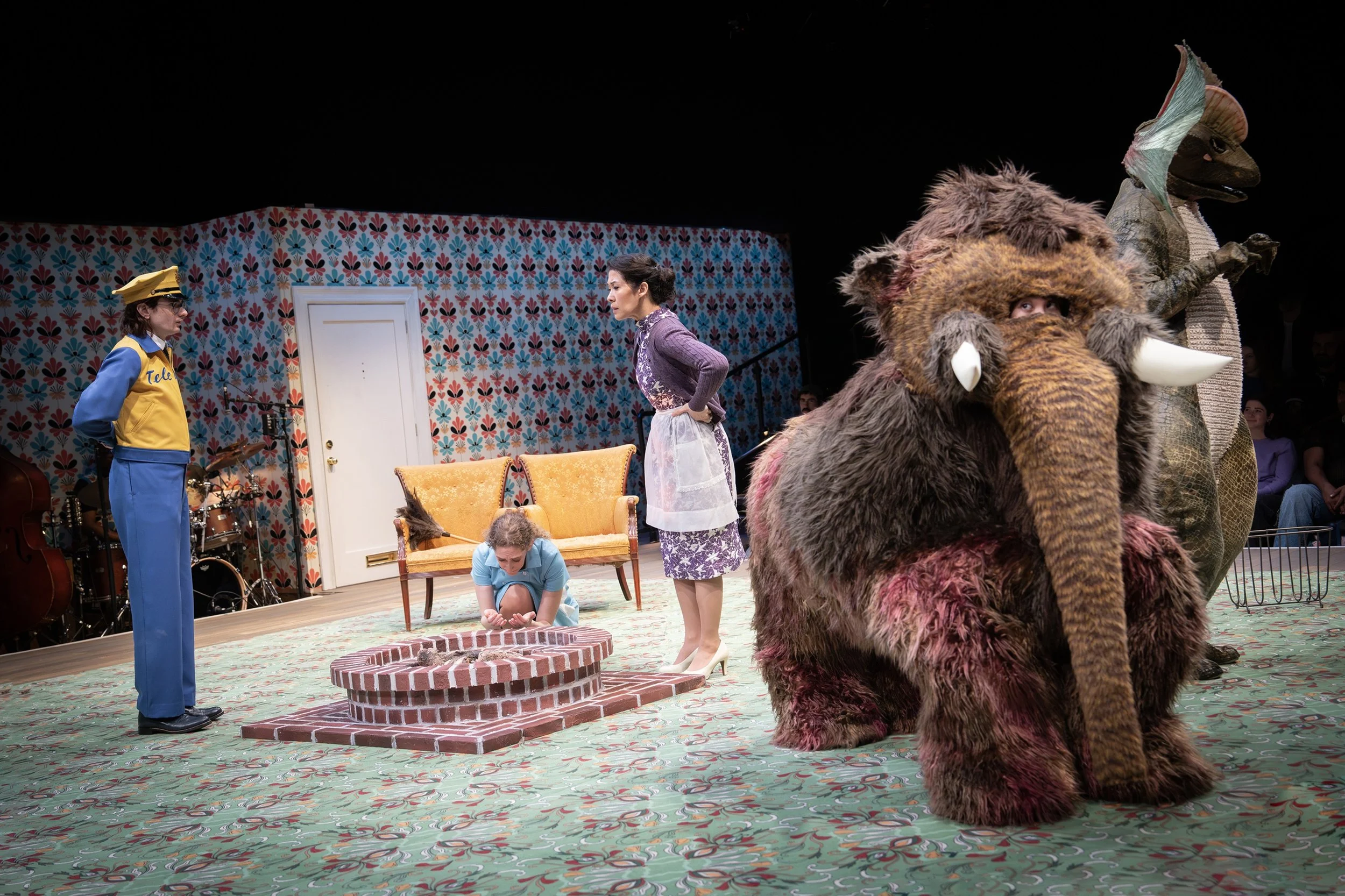
I recall it had embarrassed me, sifting in the audience that night, when the big star TalluIah Bankhead, playing the maid in the household, wearing a little black dress with small white apron and carrying a feather duster, whirled around what looked like a realistic set, the kind you'd expect in a Broadway show. Realistic, that is, until the scenery began to float through the air, and miniature dinosaurs came loping out of the fireplace. Then you knew you were in for something special. That came later in the act, but the first thing to baffle me was the moment when Bankhead suddenly dried on stage. She was alone, chatting about this and that, giving us the obligatory exposition, and somebody obviously missed an entrance cue. She said the line a little louder, but still nobody came on. She began to look a little worried. How do you make up lines with yourself, with nobody else on stage? So then she said the cue quite loudly, and we in the audience heard this whisper from the prompter, "Make something up." I was sure somebody had failed to make an entrance. How could this happen in a big Broadway production? Tallulah looked perplexed, but gamely mumbled something, repeated the cue again, this time very loudly. Nothing happened. She stood there for a minute and the whole audience was beginning to feel uneasy, as you'd expect. And then the crazy thing happened. Tallulah suddenly dropped out of her role completely and stepped right down to the foots facing us, with no attempt at all to remain in the scene, to be that maid Sabina. I remember how exasperated she seemed as she glared out at us, and then she launched into her tirade. "I hate this play and every word in it. All about the human race. Now there's a subject for you. Why can't we have plays like we used to? Plays like Smilin' Through and The Bat, plays with a message you can take home with you." Something to that effect. Then of course we all realized it was part of the play, and everybody started giggling and it grew into a big laugh going all the way up to the balcony. The stage manager was now onstage tugging at Tallulah, and that too was part of it. I was hoping to ask Wilder about that scene, and why did he want to destroy the illusion that way, break the convention of the fourth wall? Did they find that in rehearsal? Was that Kazan the director's idea, or what?

There was quite a gathering to hear Thornton Wilder that afternoon in this seminar room, with all these deep lounge chairs. Of course, the room was packed. I had to stand at the back with Ethridge, and I remember my old college roommate Dick Mack was there too. As usual he was wearing those blue-jeans, the realty tight Levi Strauss ones he calls "my Make-Believe-Ballroom-Pants." He slept in those pants.

Mrs. French was hosting, and of course Professor French was there to do the introductions in his role as House Master. He did introduce Wilder, in that grainy subterranean voice of his. It seemed to rumble up from the depths, deep inside his innards, oily and rich, like petroleum sludge, a thick dessert of a voice, which he used to enormous effect in class, particularly when he was reciting the juicier passages from The Canterbury Tales. Wife Margaret, our house mom, had gray hair which looked like an agitated halo framing her buxom face and pendulous cheeks. Professor and Mrs. French were straight out of Dickens.

All the stars of the English Department were there to pay homage. Gordon Height, Beecher Hogan and his wife, and just before they brought Wilder in, Chauncey Brewster Tinker himself appeared in the doorway, very frail, mottled facial skin, a few wisps of hair the color of chalk stranded on his scalp. He was the most extraordinary teacher, not only because he gave me an "A" in his Age of Johnson course. Of course Ethridge idolized him, and tugged at my elbow to whisper "Tink" when I turned to look. As if I didn't know "Tink."

Then a commotion at the door and suddenly Wilder was in the room. A smattering of applause as we pressed close, and now Professor French was telling us, in that subterranean voice of his, that Wilder, "Thornton," as he chummily called him, was just out of service back from Algiers and Caserta. Short, vital, black-rimmed glasses, very dark brows almost threateningly thick, a strong chin and jaw. Not much weakness or sentimentality in that face. Fierce eyes, and a way of talking which absolutely bowled me over. I was going to take notes for my journal, as I always do, but instead found myself just trying to keep up with my ears, let alone my hands. You didn't want to miss a thing. I sat there mouth gaping. It's not fair that a mortal brain should be so brimful. I was trying to jot down phrases from that fire-storm of ideas and impressions, but my scrawl couldn't keep up and grew ever more illegible. The sheer speed was exhausting as ideas and comments and pithy remarks poured out. No, not poured. That's inadequate Gushed out, like a hydrant under extreme pressure, full throttle. And the speed, the sheer speed with which he talked!

It was impossible to recall what he said in any logical sequence. I just remember fleeting bits. Carthage and the Roman amphitheatre there. What did Cleopatra say to Caesar three days before the Ides of March? Then he was off on a spiel about Pip in Great Expectations then back to Suetonius, and did we know about the naughty behavior of the Emperor Tiberius on his cliff side Villa above Capri, where little boys - Wilder called them minnows, as translated from the Latin spintrae - little boys of nine and ten in the pool with the Emperor doing unmentionable things to him while holding their breaths under water. Then more about Pip, and James Joyce, and something about the physio-chemical process involved in a sunset.

On and on he talked while we drank it in, our mouths open, like goldfish in an aquarium gulping a stream of oxygen. I could feel Ethridge next to me, breathing in that stertorous way he has, right in my left ear. His breathing would now and then stop entirely, as if his bodily functions ceased, including breathing, in order not to miss a word. I wouldn't have been surprised if he suddenly toppled over in a dead faint and lay there on the carpet twitching like a fish.

No. Wilder was unbelievable. Talk about a fire storm! This was it. An intellectual inferno of major proportions. What can you possibly say after hearing Thornton Wilder talk for an hour? Was he primed on battery juice? It was electrifying.

Afterward we clustered around, all the English Major toadies - I among them - trying to get a word in. But why on earth would Wilder want to hear any idiotic questions we might pose? Of course by this time the party temperature was gradually cooling off after all of the white heat he generated. We were becoming a bit more normal, our usual selves, despite being in the presence of the most abnormal intellect imaginable.

I tried to wedge myself close enough to ask my question about TalIulah and that first scene of Skin of our Teeth. He actually heard what I said in the crush of noise, and was answering something about hating to write 'realistic' plays. What's realistic about Our Town, where a boy and girl sit on a trestle and imagine they're having a soda at the local drugstore? And in Skin Tallulah deliberately broke the convention of the realistic theatre and upset us all until we realized it was a joke, and began laughing, the laughter of self-congratulation our realization that the writer was putting us on. Then of course we pretended we knew it all along.

What a performance Wilder put on. The crowd babbled excitedly as Mrs. French offered the great man coffee and cake. But Wilder was off, followed by the clatter of English majors and their excited chatter, leaving the room suddenly blank. "Tink" had gone too, and Gordon Height. Had Professor Height noted that I was there? That despite my performance in his class on The Victorian Novel I knew enough to pay my respects to a natural phenomenon like Thornton Wider? That I can recognize the ocean when it's thundering over me?

Ethridge and I went upstairs to his chambers for the obligatory martinis, to talk about what we'd experienced, and to hear his song birds. I am the only person my age in the hemisphere who's ever heard of Povla Frisch. Or Gita Alpar for that matter. I guess some could pin-point Amelita Galli-Curci, and we've all heard of FIagstad. But Povla Frisch? This is opera lore on a stratospheric level.

Ethridge's face was flushed. He had resumed breathing. "Wasn't that simply incredible?" Yes it was, and I wanted to know if Ethridge had kept the strands of Wilder's thoughts separate. He was intrigued with Dickens, of course, but why was Pip bobbing about in that torrent of talk? Why Carthage? Or Cleopatra?

There was one totally unexpected detour which did stay in my mind. Wilder was on some tangent about somebody, André Gide, I think. And suddenly I heard, or thought I heard, or maybe misheard, or didn't really understand, something he said about artists. I suppose he was talking about himself, but it was highly ambiguous. Artists show a predisposition to neurosis in infancy, he said. As years pass and the infant grows older, becomes adolescent, the neurosis becomes conscious of itself. Then what happens? The subject, the neurotic infant, now an adolescent, begins to feel that he's an exception. Not really part of society. Outside. Unique. Did he actually say that? Or merely infer it? You have a neurotic child, and that child begins to feel he's an exception in society, and as an exception he wants to tell all about his neurosis to everybody who'll listen, while at the same time he's desperate to conceal his neurosis. Does that make sense?

By now I was downing Ethridge's martinis along with thin wafers, slivers of cheese perched on them, tiny slivers, all but invisible so the supply would last. Ethridge was always on what he called a budget. Others might have another word for it.

As the liquor loosened us and we were talking about Wilder, I mentioned this business of the neurotic infant growing up to become a neurotic adolescent who begins to think of himself as being 'different,' the exception in society; and now in danger of being split down the middle by two conflicting desires: the desire to tell everyone just how unique, artistic, crazy he is, and the desire to keep his craziness a total mystery. Or at least a secret.

Much of what was swirling in my mind I felt uncomfortable expressing to Ethridge. Anyhow, by that time he was forcing me to guess which of his canaries we were hearing on his gramophone. Some of those voices could only be heard after he delicately sharpened the thong needle by means of which the sound reached our ears. Those singers were truly from the golden vocal past. We didn't have Jenny Lind, but Sembrich was there, and of course Adalina Patti, and Lilli Lehmann, who actually knew Richard Wagner, and even des Reszke Brothers, and Pol Plançon. A cornucopia of the great voices from long ago.

Ethridge would put on a record and turn to me with his bony face, cheeks flushed with gin, his watery blue eyes now damp with pleasure. Soon there were tears. Not of despair, or pain, but of pure joy. And Thornton Wider and the whole experience had melted into the background while we heard the limpid tones of Galli-Curci singing "Home Sweet Home", and Ethridge's mouth curled in a smile. He was experiencing something deliciously satisfying. "One of the truly great," he would tell me. "Just hear that glorious rubato."

That was memorable, that afternoon with Thornton Wilder. But I drank too many martinis. After the fifth I stumbled down to my own room where Dick Mack was lying on his bed, still wearing those tight jeans, staring at the ceiling.

This is an excerpt from the journals of Charles Nolte, which are archived in the Jean-Nickolaus Tretter Collection in Gay, Lesbian, Bisexual and Transgender Studies at the University of Minnesota. For more information about Charles Nolte and the collection, please visit the Nolte Collection website. © 2010, University of Minnesota. All rights reserved.

Tappan Wilder, Thornton Wilder's nephew, discusses the enduring appeal of "Our Town," and David Cromer's award-winning staging of "Our Town," the longest-running production of the play in its 71-year history; its record-breaking 337th performance was on December 16th. The production just passed its one-year anniversary on February 26. "Our Town" is playing at the Barrow Street Theatre, 27 Barrow Street.

Did You Know ...

Get in Touch

Do you have Wilder related news to share? Are you putting on a performance of a Wilder play? Email us with the details.